install.packages("checktor")The gap checktor fills
R CMD check answers one question well, whether this package builds and runs. The question that actually decides your submission goes unasked. Will a CRAN volunteer, reading by hand, send it back? Those are different questions, and the space between them is where afternoons disappear. A missing \value{} tag. A set.seed() left inside a function. A Description that never grew past one line. Nothing in the standard toolchain says a word about any of them.
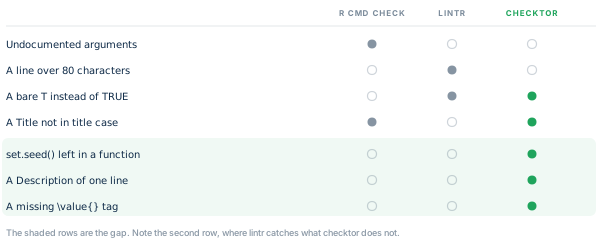
checktor is the specialist your build refers you to before that appointment. It runs the extra-CRAN checks that live in the Repository Policy and reviewers’ long memories but nowhere in the standard toolchain, and, true to the name, it gives you a checkup, a diagnosis, and a prescription.
Installation
checktor is on CRAN, so you can install it the usual way.
If you want the cutting-edge development version, with the latest changes before they reach CRAN, install it from GitHub.
# install.packages("pak")
pak::pak("coatless-rpkg/checktor")
A first checkup
Load the package first.
That brings checktor() and its helpers into your session, so from here everything is a single function call, and the natural place to begin is a checkup.
checktor() examines a package directory. So we can watch it work without maiming your own package, we will point it at a throwaway package built around one deliberately bad file.
pkg <- example_diagnose_scenario("code_examples/tf_usage_bad.R",
                                 show_content = FALSE)
Here is the file it was built around, bad habits and all.
# Example file showing T/F usage issues

#' Process Data Function
#' @param data A data frame
#' @return Logical indicating success
process_data <- function(data) {
  if (is.null(data)) {
    return(F) # Issue: should be FALSE
  }

  has_complete_cases <- T # Issue: should be TRUE

  if (has_complete_cases) {
    cleaned_data <- data[complete.cases(data), ]
    return(T) # Issue: should be TRUE
  }

  return(F) # Issue: should be FALSE
}

# Another function with T/F issues
validate_input <- function(x, strict = T) {
  # Issue: should be TRUE
  if (length(x) == 0) {
    return(F)
  } # Issue: should be FALSE

  valid <- all(is.numeric(x))
  return(valid && strict == T) # Issue: should be TRUE
}
Left to itself,
example_diagnose_scenario()prints that file for you, becauseshow_contentdefaults toTRUE. We passFALSEand render it above instead, so it arrives as highlighted R rather than console output.
Now the checkup itself.
# verbose and progress are off here, which keeps the printout compact
results <- checktor(pkg, verbose = FALSE, progress = FALSE)
results
#> ── Package Doctor - Diagnosis Summary ──────────────────────────────────────────
#> Patient: examplepackage
#> Examined: 2026-09-28 22:25:45.963769
#> Doctor version: 0.2.0
#>
#> CODE ISSUES: 1 failing check
#> DESCRIPTION ISSUES: HEALTHY
#> DOCUMENTATION ISSUES: HEALTHY
#> GENERAL ISSUES: HEALTHY
#> POLICY ISSUES: HEALTHY
#>
#> ℹ 2 checks did not run: "spelling" and "url_liveness".
#> ! Overall health: NEEDS ATTENTION (7 issues)
#> Run `summary()`, `issues()`, or `prescribe()` for details
That bedside summary names which of the five categories (code, DESCRIPTION, documentation, general, and CRAN policy) need attention, and gives an overall verdict. For the full catalogue of what each category checks, see the function reference.
On your own package, the call is simply
checktor(). It works from anywhere inside the package, so calling it with your working directory inR/ortests/testthat/still examines the whole package.
Reading the results as data
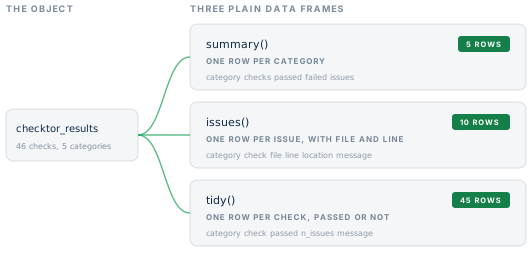
The printed report is for humans. When you want to compute on the findings, filter them, count them, fold them into a report of your own, reach for the accessors. They return plain data frames, so you never spelunk through nested lists.
summary(results)   # one row per category
#>        category checks passed failed skipped issues
#> 1          code     16     15      1       0      7
#> 2   description     23     22      0       1      0
#> 3 documentation     17     17      0       0      0
#> 4       general      7      6      0       1      0
#> 5        policy      4      4      0       0      0
issues(results)    # one row per issue, with file and line
#>   category    check   severity           file line          location
#> 1     code tf_usage robustness tf_usage_bad.R    8  tf_usage_bad.R:8
#> 2     code tf_usage robustness tf_usage_bad.R   11 tf_usage_bad.R:11
#> 3     code tf_usage robustness tf_usage_bad.R   15 tf_usage_bad.R:15
#> 4     code tf_usage robustness tf_usage_bad.R   18 tf_usage_bad.R:18
#> 5     code tf_usage robustness tf_usage_bad.R   22 tf_usage_bad.R:22
#> 6     code tf_usage robustness tf_usage_bad.R   25 tf_usage_bad.R:25
#> 7     code tf_usage robustness tf_usage_bad.R   29 tf_usage_bad.R:29
#>           message
#> 1 T/F usage check
#> 2 T/F usage check
#> 3 T/F usage check
#> 4 T/F usage check
#> 5 T/F usage check
#> 6 T/F usage check
#> 7 T/F usage check
tidy(results) gives one row per check, passed or not, and as.data.frame() is its alias. Its skipped column marks any check that did not run, such as the URL fetch when you are not at the console, so a check that sat out never reads as one that passed. summary() counts such a check under skipped, so passed, failed and skipped add up to checks. Three helpers answer the common questions directly:
is_healthy(results)
#> [1] FALSE
n_issues(results)
#> [1] 7
failed_checks(results)
#> [1] "code.tf_usage"
is_healthy() and n_issues() follow the verdict, counting only the policy and robustness tiers, while issues() and failed_checks() list every tier, opinion included. Each accessor also works on a single category, as in issues(results$code_issues), or on a single check.
The one-line gate
For scripts and pre-submission checklists, checkup() collapses the whole diagnosis to a single verdict, TRUE when the package is clean:
checkup(pkg)
#> [1] FALSE
Built to be the last word in a shell one-liner, it takes charge of a GitHub Actions build in the checktor in Continuous Integration vignette.
From diagnosis to treatment
A diagnosis you cannot act on is just bad news. prescribe() turns each finding into a concrete remedy, with the before and after spelled out.
prescribe(results)
#> ── Treatment Recommendations ───────────────────────────────────────────────────
#>
#> ── T/F Usage Issues
#> Issues found:
#> • tf_usage_bad.R:8
#> • tf_usage_bad.R:11
#> • tf_usage_bad.R:15
#> • tf_usage_bad.R:18
#> • tf_usage_bad.R:22
#> ... and 2 more
#> Treatment: Replace `T` with `TRUE` and `F` with `FALSE`
#> # Before
#> result <- T
#> # After
#> result <- TRUE
#>
health_report() writes the whole consultation to a file, as Markdown, HTML, or plain text, to keep alongside your cran-comments.md:
health_report(results, file = "package-health.md")
health_report(results, file = "package-health.html", format = "html")
Examining one system at a time
Each category runs on its own, which helps when you are fixing one thing and would rather not hear about the others:
diagnose_code_issues()           # just the R sources
diagnose_description_issues()    # just DESCRIPTION
diagnose_documentation_issues()  # help pages, examples, vignettes, demos
diagnose_general_issues()        # size, URLs, NEWS, README links
diagnose_policy_violations()     # CRAN policy
Checking only what is included
R CMD build drops whatever .Rbuildignore matches, and checktor drops the same files. A help topic or vignette held back from the tarball is never checked.
The devtag package uses this to document unexported functions: @dev writes the help page and adds the .Rd to .Rbuildignore, so contributors see it and users do not. Those examples can call ::: and checktor will not object. The pkgdown-only articles usethis::use_article() writes to vignettes/articles/ work the same way.
roxygen_usage is the exception. It reads all of man/, since it asks whether your working tree is in sync with roxygen rather than what is included.
Turning down the volume
checktor() is chatty by design. In a script, quiet it once and every later call inherits the setting:
configure_doctor(verbose_default = FALSE, progress_default = FALSE)

# or per call
results <- checktor(verbose = FALSE, progress = FALSE)
Checks you ask for, and checks you turn off
A few checks never join a run, because no authority backs them or they ask about your submission workflow rather than the package itself. They are not skipped, since nothing tried to run them. A quiet run does not mention them, but the results name them:
results$metadata$on_request_checks
#> [1] "cph_role"                    "cran_comments_file"
#> [3] "description_function_quotes" "format_names"
#> [5] "title_starts_with_article"
Each one is a lab_*() function like any other check, so running it is one call:
lab_cran_comments_file(pkg, verbose = FALSE)
#> ✔ cran-comments file check: PASSED
Going the other way, a check you have decided against can be turned off. For one package, name it in that package’s DESCRIPTION:
Config/checktor/disable: news_fileFor every package, set the option once, for example in .Rprofile:
options(checktor.disable = "news_file")A disabled check does not run and is not counted anywhere. That is the difference from a skipped check, which was meant to run and could not.
Where it fits
Run checktor in the gap between writing code and R CMD check:
Conclusion
checktor is a checkup, not a cure-all. It complements R CMD check and lintr rather than replacing either, and it cannot replace your judgment about whether a package is worth submitting. What it does do is the one thing those tools do not, remembering the hand-enforced CRAN rules so you do not have to. Run the three together, treat the printed report as the conversation and the accessors as the data, and a reviewer should find nothing left to say. That is the entire point.
See also
- Where the Checks Come From: the source and severity tier behind every check, from CRAN policy to convention.
-
What R CMD check Checks: every step
R CMD checktakes, so you can see where checktor begins. -
checktor in Continuous Integration: put
checkup()in charge of a GitHub Actions build as a quality gate. - Writing Your Own Checks: add project-specific checks against the parsed syntax tree.
- Function reference: the full catalogue of diagnostics.