# A throwaway package that deliberately uses T/F instead of TRUE/FALSE
bad_pkg <- example_diagnose_scenario("code_examples/tf_usage_bad.R",
                                     show_content = FALSE)

checkup(bad_pkg)
#> [1] FALSEYou already run checktor on your package. The trouble with running it by hand is that you do it when you remember to, which is not the same as every time it matters. A pipeline has no such lapses, running the check on every push, for every contributor, whether or not anyone remembered to.
Moving the check into continuous integration (CI) turns a good habit into an unconditional one, in about as many lines of YAML as it takes to describe.
The one function CI needs
Everything in this article rests on a single function. checkup() runs the full diagnosis and collapses it to one verdict: TRUE if the package is clean, FALSE if a policy or robustness finding wants attention. Opinion findings are still reported, but they do not fail it.
A healthy package returns TRUE. That is the entire contract, and it is all a build needs to decide whether to go green or red.
A GitHub Actions job
checkup() is designed to be the last word in a shell one-liner. Drop this file in at .github/workflows/checktor.yaml and you have an extra-CRAN gate on every push and pull request:
name: checktor

on:
  push:
    branches: [main, master]
  pull_request:

jobs:
  checktor:
    runs-on: ubuntu-latest
    steps:
      - uses: actions/checkout@v7

      - uses: r-lib/actions/setup-r@v2
        with:
          use-public-rspm: true

      - uses: r-lib/actions/setup-r-dependencies@v2
        with:
          extra-packages: any::checktor

      - name: Run extra-CRAN checks
        run: if (!checktor::checkup()) quit(status = 1)
        shell: Rscript {0}
The job checks out your package, installs checktor, and exits non-zero the moment checkup() disagrees with you.
any::checktorinstalls the release from CRAN. To run the development version instead, usecoatless-rpkg/checktor, which installs from GitHub.
Failing loudly, not silently
A red X that says only “exit code 1” is a riddle, not a report. When a build fails, you want the diagnosis in the log, not a scavenger hunt. Run the full checktor() once and print the report before you quit:
results <- checktor::checktor()

if (!checktor::is_healthy(results)) {
  writeLines(checktor::health_report(results))  # the diagnosis, in the log
  quit(status = 1)                              # then fail the build
}
health_report() returns the findings as Markdown, so the failing log reads like a chart at the foot of a hospital bed, showing what is wrong and where. Point its file = argument at a path and you can just as easily upload the report as a build artifact for the squeamish who prefer not to read CI logs.
Tuning the examination
CI is chatty by nature, so quiet the doctor down. configure_doctor() sets the verbosity and progress defaults once, at the top of a script, and every later call inherits them:
checktor::configure_doctor(verbose_default = FALSE, progress_default = FALSE)You can also run a single category when that is all you care about, since each diagnose_*_issues() function stands on its own, and a single check the same way through its lab_*() function:
# Gate only on DESCRIPTION-field problems
desc <- checktor::diagnose_description_issues(".", verbose = FALSE)
if (!checktor::is_healthy(desc)) quit(status = 1)

# Or on one check on its own
tf <- checktor::lab_tf_usage(".", verbose = FALSE)
if (!checktor::is_healthy(tf)) quit(status = 1)
A category or a single check has no verdict tiers to filter by, so is_healthy() on one fails on any finding, opinion included. Use checkup() when the tiers matter.
Findings on the diff, not in the log
A log someone has to scroll is the weakest way to deliver a finding. Every forge can put one next to the line that caused it, and ci_report() writes whichever shape yours reads. With no arguments it examines the package, works out where it is running, and emits the right thing.
checktor::ci_report()On GitHub Actions that prints workflow commands, and each finding appears on the pull request diff:
::error file=R/plot.R,line=42,title=checktor%3A option_changes::Option changes check: plot.R:42The colon in the title is written as %3A, the escape GitHub expects there. Gitea and Forgejo Actions read the same commands, so the same call covers them. ci_report() also recognises GitLab, Azure Pipelines and Jenkins from the variables they set. Name the format when you want a different one, such as SARIF for GitHub code scanning, or when the build runs somewhere it does not recognise:
| Forge | Format | What to do with it |
|---|---|---|
| GitHub, Gitea, Forgejo | "github" |
Printed to the log, shown on the diff |
| GitLab | "gitlab" |
Name it in artifacts:reports:codequality:
|
| Azure Pipelines | "azure" |
Printed to the log |
| Jenkins, reviewdog, review bots | "checkstyle" |
Read the XML with the warnings plugin |
| GitHub code scanning | "sarif" |
Upload with github/codeql-action/upload-sarif
|
A GitLab job needs only this:
checktor:
  image: rocker/r-ver:latest
  script:
    - Rscript -e 'install.packages("checktor"); checktor::ci_report(format = "gitlab")'
  artifacts:
    reports:
      codequality: gl-code-quality-report.json
ci_report() reports every tier, since an annotation is information rather than a verdict. Keep checkup() for the verdict, so what fails a build stays a separate decision from what gets pointed at. If you want an opinion to fail a build, that is checkup(severity = c("policy", "robustness", "opinion")), and the threshold stays in one place rather than being spelled two ways that can disagree.
Checks that did not run are named once at the end, rather than one annotation each, because a check that never happened should not compete for space with a finding:
::notice title=checktor%3A skipped::2 checks did not run: spelling, url_livenessFor the report formats that note goes to the job log instead, keeping the artifact a clean document. Pass skipped = FALSE if you would rather not hear about it.
Keeping the report
health_report() writes the whole consultation to a file, which an artifact step can keep for later. Write the report in the step that runs the gate, before the gate decides:
      - name: Run extra-CRAN checks
        shell: Rscript {0}
        run: |
          results <- checktor::checktor(verbose = FALSE, progress = FALSE)
          invisible(checktor::health_report(results, file = "checktor-report.md"))
          if (!checktor::is_healthy(results)) quit(status = 1)

      - name: Upload checktor report
        if: always()
        uses: actions/upload-artifact@v7
        with:
          name: checktor-report
          path: checktor-report.md
Writing the report before the gate runs, and uploading it with if: always(), means a failing build still leaves the findings behind after its log has scrolled away. checktor’s own workflow does exactly this.
What a runner does not check
Two checks sit out in CI, because the result would say more about the runner than about your package. The URL fetch waits until you are at the console, and spelling waits until a spell-check backend is installed. Neither is reported as a pass. They come back marked skipped, they are named in metadata$skipped_checks, tidy() carries a skipped column, and ci_report() says so on the build itself, so a green build never implies a check that never happened.
Turn the URL fetch on in a job that should do it, keeping in mind that a network hiccup then becomes a red build:
options(checktor.url_check = TRUE)Closer to the keyboard
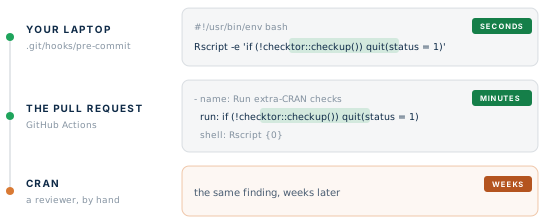
CI is the backstop, not the first line. If you would rather hear about a problem before it reaches a pull request, the same one-liner works as a local Git pre-commit hook:
#!/usr/bin/env bash
# .git/hooks/pre-commit  (make it executable: chmod +x .git/hooks/pre-commit)
Rscript -e 'if (!checktor::checkup()) quit(status = 1)'
Now a commit that would have embarrassed you on CRAN never leaves your laptop.
It is the same call in both places, and the only thing that changes is how long you wait to hear about it.
The takeaway
Wire checkup() into CI once and the rules stop living in your head, where they were never safe anyway. The best submission is the one where the reviewer finds nothing to say, and the surest way there is to have already said it to yourself, automatically, on every push.
See also
- Getting Started with checktor: the guided tour of the diagnostics.
- Writing Your Own Checks: add project-specific checks against the parsed syntax tree.